

When the Tool Stops
On sculpture, interruption, and what reveals itself when progress breaks apart

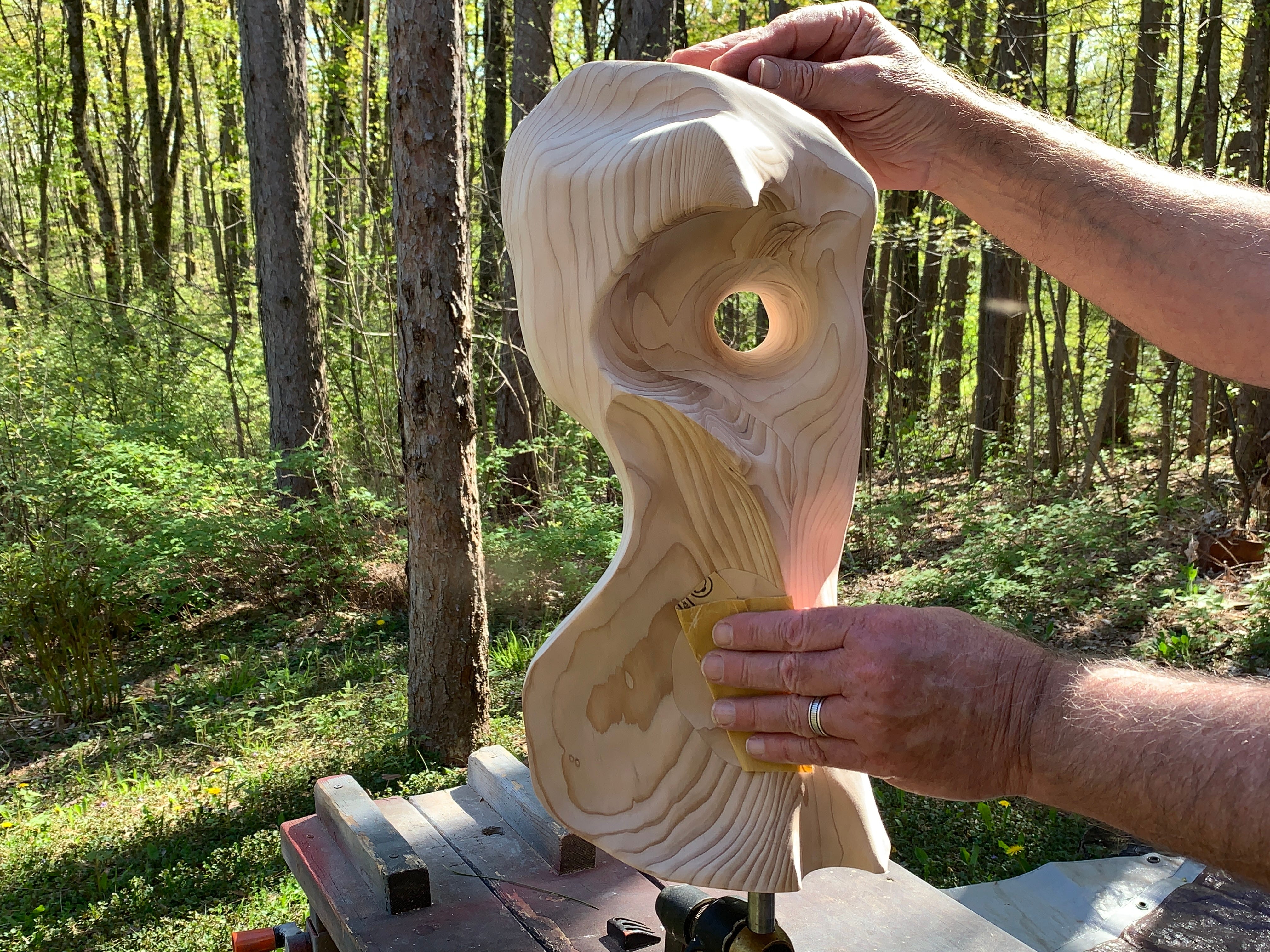
Yesterday, I spent twenty minutes staring at a pile of Douglas Fir shavings on my studio floor.
They curled in on themselves, fragile, thin, brittle, almost weightless. When I crushed one between my fingers, it released a sharp, citrus scent, as if the tree were still trying to speak through what remained of it. The light caught their edges in a way that made them feel more deliberate than debris, more like a fruitful product than waste.
I had just stepped away from the working sculpture, or maybe the work had stepped away from me.
There is a strange, unsteady feeling that follows that kind of ending of the typical day in the studio. Not quite a feel of failure, not quite completion. But something quieter in tone. A suspended place where the usual measures, progress, productivity, and purpose don’t seem to apply.
For a while, I stood there, unsure what I was looking at. Sometimes you find that wood can be mysterious.
Was I uncovering something beautiful, both in form and in its colorful grain… or just losing a fight with the material?
I find myself caught between two impulses that don’t resolve that feeling. And that is the need to justify the hours with visible progress, and the growing suspicion that the most meaningful part of the work begins only after the movement stops and the dust settles.
This is the certain space I would like to explore with a pensive thought. And that hope is the slim, narrow chance with an uncertain distance between doing and being, between shaping something and simply standing in front of what remains.
There is a philosophical concept that speaks quietly to this moment.
It suggests that we don’t really notice our tools while they are working. When everything is moving as it should, the tool seems to blend into the background. The chisel is no longer an extremely sharp tool; it becomes an extension of your body and mind, and it creates a direct line between intention and form itself. There is no distance, no interruption between the tool, hands, and the work.
But if during that moment something breaks that special moment, when the blade catches, when the grain refuses to work with it, that seamless connection seems to dissolve.
And suddenly, in the moment, the tool is just a tool again.
It feels heavy, cold, and separate.
And with that separation comes a slight kind of vertigo.
When the tool stops working, so does the special identity attached to it. You are no longer the sculptor in motion, with fine crisp shavings falling. You are simply a person holding a shiny piece of steel against a piece of wood that no longer agrees with you.
It feels like a loss of function with a purposeful moment.
But more than that, it feels like a loss of meaning.
In everyday life, this shows up in quieter ways. A plan you worked on that no longer holds. A specialized rhythm that breaks. A sense of forward motion that suddenly collapses into inaction. And in that placidity, the question emerges:
If I’m not moving forward… what am I?
I’ve seen this tension made visible in the work of Doris Salcedo, particularly in her Articulated Cloud series.
She takes ordinary wooden objects that could be chairs, wardrobes, or fragments of domestic life, and binds them with concrete. They are forced into repose, locked into positions they were never meant to hold. The familiar feeling can become heavy, arrested, almost suffocated.
What her work reveals is not that specialized movement, but its absence.
Gone is the response and the weight that remains when action is no longer possible.
It becomes a kind of visual language for interruption, for the moment when this time of creation stops behaving the way we expect it to.
In that visual sense, her work functions less as representation and more as a focused lens. It allows us to see the density of inactivity and recognize that what appears inactive is often holding something far more complex than motion.
In organic abstraction, this can become a mirror to symbolize stoppage or impediment.
The finished form, the thing that no longer changes, carries within it every decision, every resistance, every moment where the process could not continue as planned. It is not just evidence of control.
It is evidence of where control ended, and sometimes a pivot is needed.
Working with Douglas Fir, especially by hand, is never a smooth conversation.
I tend to choose the pieces others leave behind, the ones where the grain twists unpredictably, where the growth rings tighten into knots that resist any clean direction. There is something in that resistance that feels necessary.
But it comes at a cost, especially when working with it.
There is a sound the chisel makes when things are going well, a soft, steady slice as the blade moves through the fibers. It’s a reassuring sound. It suggests alignment, cooperation, and a shared direction between hand and material.
And then, without warning, that sound can change with a lewd thud, and it fractures in different directions than planned.
The sound of the slice breaks into something sharper, a hollow snap, a crack that travels through the piece and back into the body. It’s the sound of refusal from the material. The moment the wood asserts its own history over whatever I had intended.
That happened recently to me in the studio.
One strike that sounds slightly off. A hidden twist beneath the surface. The blade met it, and everything stopped at once. The sound echoed, then disappeared, replaced by a silence that felt almost aggressive in its suddenness.
Thankfully, the piece wasn’t destroyed. But it wasn’t what I thought it was, either.
And this is where the usual advice begins to fall apart. The idea that there is a cleaner path, a better choice, a more efficient way forward. That you should simply adjust, correct, and optimize in a slightly different direction.
But none of that addresses what actually happened.
Because what emerged in that break, the uneven surface, the unexpected tear in the grain, began to hold light in a way I couldn’t have designed. It created a pattern that only existed because something went “wrong.”
There is no five-step process to get back on the right path.
No method for arriving at what can only appear through disruption.
Because this “mistake” is not a detour but a condition that made the result possible.
Conclusion
I’m beginning to suspect that the moment the tool stops is not the end of the work.
It is the point where something else becomes visible.
Not something added, but something revealed because the medium, wood, can be the teacher or master.
The patterns that can develop from those interruptions, the ones shaped by struggle and by refusal of the piece, carry a kind of clarity that smooth and flowing progress rarely produces.
They hold a different kind of certainty that doesn’t come from control, but from dealing with the encounter.
And maybe the discomfort we feel in those moments isn’t a sign that something has gone wrong.
Maybe it’s a signal that we’ve reached the edge of what we can impose, and are about to see what was already there.
So I’m left with a question that doesn’t resolve, but lingers.
Where in your own life are you so focused on maintaining the rhythm, the steady hiss of forward motion, that you’re missing what only reveals itself in the sound of a snap?
What might be waiting in the silence that follows, if you allowed it to remain just a little longer?
This essay is part of The Shape of Stillness, an ongoing series exploring sculpture, perception, stillness, and the interior life of making.
If these reflections resonate with you, consider subscribing to receive future essays and studio writings from the quiet studio.